
June 2026
Earlier this year, the Kamitei team made the long trip south — from Iringa through the flooded roads of the Kilombero Valley and further, to communities near the Mozambique border that few visitors ever reach. What they found, and who they met, tells the story of where Kamitei is going next.
Tanzania is a big country. Kamitei’s work spans two regions — Northern and Southern — each covering vast distances and very different landscapes. In the North, the work is anchored in Karatu and the Makame Wildlife Management Area (WMA). In the South, three areas border the national parks of Ruaha and Nyerere — two of Tanzania’s largest wilderness reserves — with a fourth encompassing the Ruvuma 5 WMAs, deep in the country’s far south near the Mozambique border. The distance from Kamitei’s base in Arusha to the Ruvuma 5 is roughly equivalent to driving from Amsterdam to Lisbon.
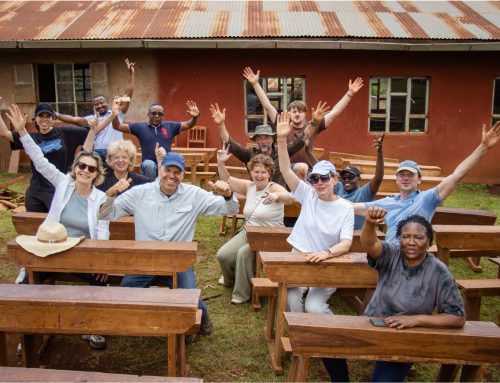
The team that made that trip included Jane Ngwatu — Kamitei’s co-founder, known to these communities as Mama Kamitei — Field Education Coordinators (FECs) Billy and Rashid, Astrid from the Netherlands board, and Gladness from one of our partner organisations, Honeyguide Foundation. Their route took them south from Iringa down into the Kilombero Valley — a broad, fertile floodplain that in the wet season floods roads and cuts off communities for weeks at a time. When the team travelled through, sections of road had become rivers. In places, local people waded ahead of the vehicle to check the depth before the team could continue. For Astrid, it was a vivid lesson in what rooted locally means in practice.
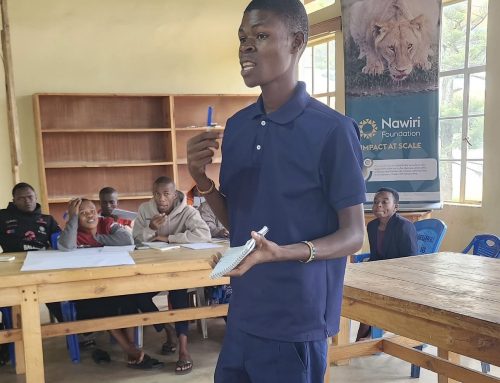
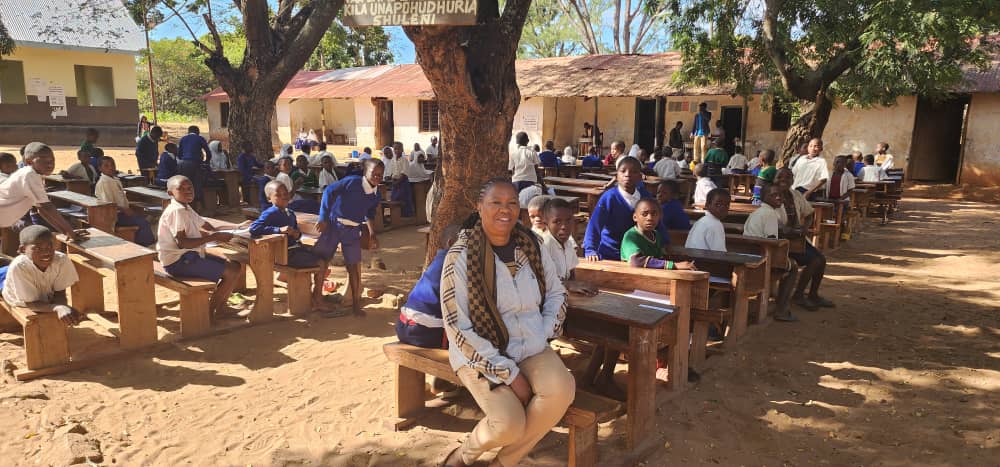
Their first stops were schools in the areas bordering Ruaha and Nyerere that Kamitei has supported since 2024 through a partnership with Nawiri Group, Six Rivers Foundation and Honeyguide Foundation — at Msolwa Station, Kibong’oto, Ukombozi, Katurukila and Magombera, among others. Classrooms that had been bare now had Kamitei Foundation desks. Books distributed in previous visits were in active use. Atlases, Kiswahili dictionaries and exercise books were visible on walls and in children’s hands.
The three Field Education Officers (FEOs) based in the south — former KITE interns now coaching interns and monitoring schools across the region — were demonstrating the kind of daily commitment that makes sustained improvement possible. Flooding prevented the team from reaching Mtukula, where three KITE interns are based and significant progress has already been made — a reminder that the infrastructure challenges making these communities hard to reach are the same ones making quality education so difficult to sustain, and so necessary.
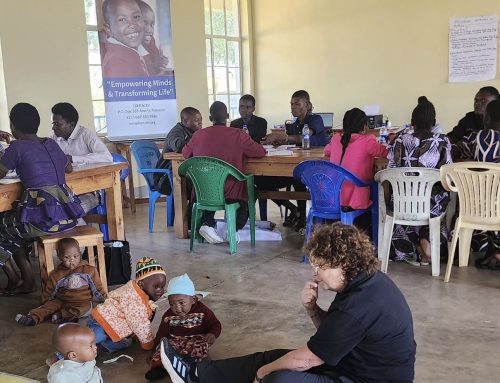
Further south, the team reached the Ruvuma 5 WMAs — five community-owned conservation areas in some of Tanzania’s most rarely visited territory. Across 45 primary schools, nearly 20,000 students face severe shortages of teachers, desks, classrooms and books. Kamitei plans to begin support here during 2026, with the expectation that from 2027 the WMAs will fund the program through carbon credit revenues — the same model proving so effective at Makame WMA. But first, our team knew they had to go and see it. They had to sit in the classrooms, talk to the headteachers, understand what each community needs. That is what this visit was for.
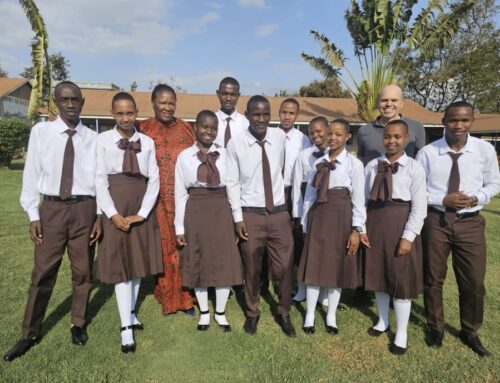
It was on this same trip that the team met Paschalina at Magazini School — a young woman who had once been a Kamitei Eagle Scholarship student in Northern Tanzania, more than 1,000 kilometres away. Today, she is a qualified teacher, employed at the school, giving children in the far south the same quality of education that Kamitei once made possible for her.
Scaling up, it turns out, sometimes takes on a life of its own — and that’s as we want it — results-oriented, resilient and rooted locally.